


How readers’ eye movements become concrete insight into reading development (part 2 of 4)
In the first part of our series we saw how timekeeping plays an important role in reading guidance. In a sense, eye-tracking can be seen as a highly efficient stopwatch. Eye movements also offer other perspectives on reading, but this part focuses on the possibility of seeing how reading time is distributed across the continuous reading of a page. In the next parts, the series looks at how eye-tracking can follow reading development and at automatic decoding of single words in context.
Eye-tracking in reading guidance in practice
Observing a student reading aloud is the reading specialist’s most direct way of learning how the student uses letters and speech sounds as building blocks to decode words and sentences, and thereby reach coherent comprehension.
For a dyslexic student, the path towards more confident reading requires a much greater effort in reading practice than for classmates without reading difficulties. This effort naturally requires support and encouragement, as well as robust tools and methods of guidance.
EyeJustRead records eye movements while the student reads e-books aloud. The student’s voice is recorded too, so the specialist can play back the reading aloud and the eye movements together, and follow the reader’s accuracy and reading strategies. In the following we focus on eye movements, because with EyeJustRead they can add an entirely new dimension to the reading specialist’s practice.
E-books + eye-tracking = an assessment tool
Because EyeJustRead shows e-books on the computer, we know exactly where and when each word is on the screen. During reading, the eye tracker records the student’s eye movements across the text, and this reading data is what allows EyeJustRead to provide relevant and reliable measures of what the student’s reading looks like and how it develops.

Back in 2016, the Danish National Centre for Reading (Nationalt Videncenter for Læsning) pointed out in its report on a larger pilot programme with EyeJustRead that:
With EyeJustRead, teachers gain insight into what students actually do when they read. This is markedly different from earlier practice, where the teacher had to base guidance on a combination of their own observation of the result of the student’s reading attempt (what the student reads aloud) and the student’s own stated assumption about what he does. (NVFL 2016, our translation)
The report also pointed to a number of opportunities in analysing the collected eye and voice data. Since the pilot, this data potential has been a major part of the development work at EyeJustRead. Below is an example of the insight that precise eye data from a student’s reading can give into the student’s reading development.
An example
All the figures below are based on data from the same page of the book “Bassemand og Miranda får en Have”. The student read the whole book from the beginning, but here just one page has been extracted to show how eye-tracking reflects reading.
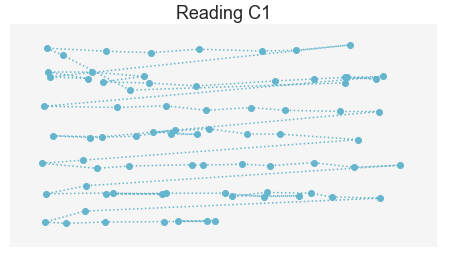
The raw fixations are the basic eye movements that directly show what the reader is focusing on. Fixations last from 1/20 of a second to several whole seconds. In the figure above, fixations are marked with dots and alternate with saccades, shown as dotted lines. Together, the trail of fixations and saccades forms a so-called scanpath. In the figure, the order of the fixations is hard to make out in several places, especially where the eyes jump back and forth between the same areas of the text. Even so, you can sense how the fixations are spread in fairly even lines, in a pattern that resembles the position of the words on the page.
Reading time and order
Before we try to judge whether the reading above looks fluent, we can look at the same data illustrated in a slightly different way. By removing the line breaks in the text, both the order of fixations and the fixation times on every word stand out more clearly.
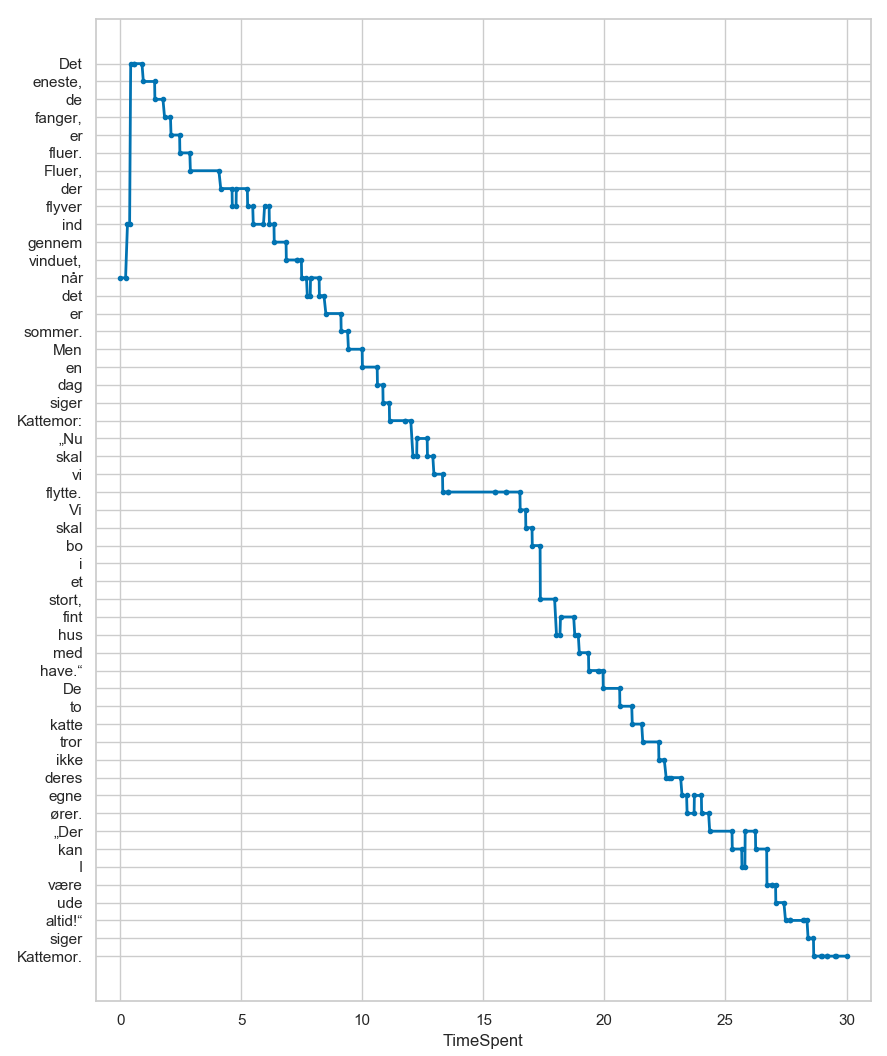
Here, the words of the text are listed from first to last down the vertical axis, and reading time can be read on the horizontal axis.
In the staircase diagram above, words that took a long time to read appear as long, flat steps. Words that were looked at in a different order than they appear in the text form vertical steps in the diagram: a steep wall when the eyes jump back in the text, and a deep shaft when they jump forward. There are 5 seconds between the vertical gridlines on the x-axis. In other words, the student spent 30 seconds reading the 51 words on the page. That corresponds to an average reading speed of 102 words per minute.
What can you expect?
Imagine a reading at a completely constant speed: it would draw a perfectly even staircase, word by word, from the top left corner to the bottom right corner. Such a perfectly even “reading staircase” is not a meaningful ideal, just as perfectly even pronunciation sounds robotic. Unnaturally even reading like this can sometimes be seen in scrolling text, film credits, some scientific reading experiments and in programmes designed to train speed reading. But when skilled readers have the option of jumping back in the text, they tend to use it in about 10-15% of fixations. Skimming, on the other hand, is characterised by many jumps several words forward in the text. At full stops, even the most skilled readers usually spend a little extra time understanding the sentence, and when reading aloud, an experienced reader’s eyes often run well ahead of the voice and back again, which lets the reader plan stress and intonation.
The staircase above is somewhat irregular, which reveals that the overall reading speed hides a more nuanced picture. Changes in speed and jumps can point to both easier and harder passages for decoding, which may be worth analysing more closely.
In the next part of this series, we use an analysis of repeated reading to suggest how reading development, in the form of more fluent reading, can be read from eye movement recordings.
By Sigrid Klerke, EyeJustRead
References
NVFL 2016: Reusch, C. (2016), Evaluering af afprøvningsforløb med EyeJustRead (prototype). (In Danish.) Nationalt Videncenter for Læsning. www.videnomlaesning.dk
Want to see how EyeJustRead works with your own students? Try the demo free for 4 weeks.