


How readers’ eye movements become concrete insight into reading development (part 3 of 4)
The previous parts of this series focused on fluent reading as a goal and on eye-tracking as a new tool for following students’ reading development. In this part, we use repeated reading to show how eye-tracking can make an individual student’s reading development visible, before the last part looks more closely at what the development of automatic decoding of single words can look like.
Repeated reading as a model of fluent reading
The following example is based on the same page from the same book. The image below is a screenshot from the playback of one of the readings. It shows two seconds of the reader’s eye movements as a so-called scanpath. The circles show where the student focused during reading, and the size of each circle indicates the length of the fixation.

We now look more closely at the eye movements of one student who read the same book from the beginning three times in a row (what many know as repeated reading). The page above has been extracted from each of the three readings to show the student’s reading development over time.

From the raw images of where the fixations land on the screen, we can see that repeated reading leads to fewer fixations, fewer jumps back, and larger and more even distances between fixations. The eye movements look more and more like those of strong readers. In this way, the image also gives a sense of how repeated reading can give the student a taste of the experience they are working towards: confident reading, where words are mostly recognised and can be read at first sight, in other words decoded automatically.
A picture of more fluent reading
In the previous part, the reading was also shown as a staircase, with the words on the page down the y-axis and the total reading time along the x-axis. The diagram is shown below as well, this time with all three repeated readings combined in one staircase diagram. The diagram makes it clear where repetition has helped the student save time. It also reveals where in the readings the student manages to reduce both the number of refixations and the length of the fixations.
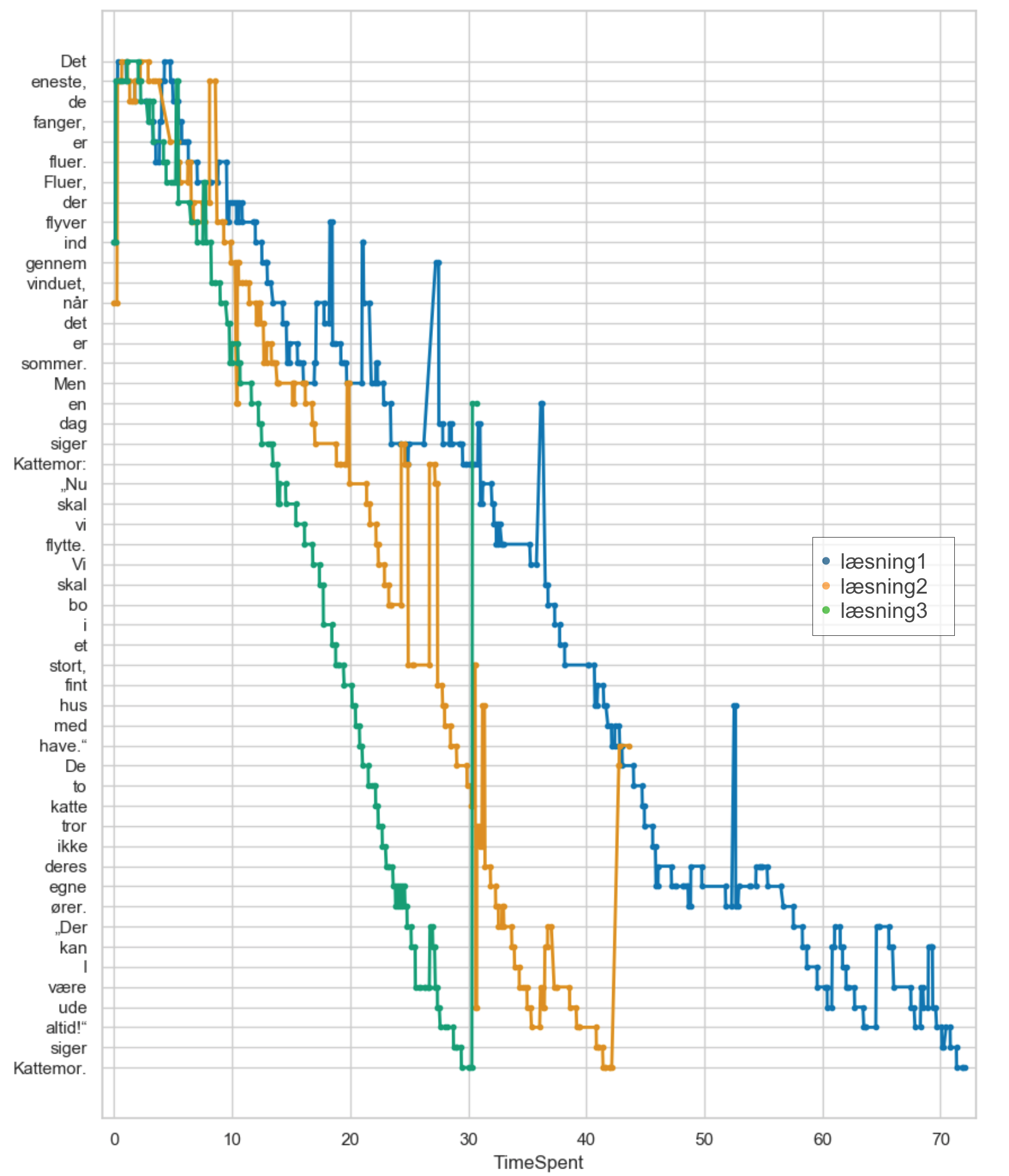
In the diagram, the first reading is the blue staircase, which reaches furthest to the right and stretches over 72 seconds. The second reading is the orange staircase in the middle, which ends after about 42 seconds, and the third reading is the steep green staircase furthest to the left, completed in just 30 seconds. The student’s average reading speed thus increases from 43 to 102 words per minute over the three readings.
What takes time, and what gets easier?
The horizontal plateaus show that a whole series of words take the student more time and require more visits to decode, especially during the first and second readings.
The cases where the student needed to go several words back in the text and start again appear as a repeated section of staircase, for example in the first reading of the words “når det er sommer” (“when it is summer”). The student’s need to go back and reread parts of the text decreases over the three readings.
The last striking difference is that the diagram has fewer sharp spikes over the three readings. The sharp spikes show brief jumps back in the text. Quick jumps back during reading can reflect a slightly imprecise fixation that landed a line too high and is then corrected. The student may also have taken a moment to refresh a word read earlier, but in both cases the sharp spikes can probably be seen as a sign that the student’s reading flow has been broken. We can only say probably, because at the time there was no research that had systematically interpreted complex eye movement patterns of this kind in continuous reading.
Repeated reading as the basis for an individual model
For EyeJustRead to provide a relevant and precise overview of each student’s individual reading development, the system has to take into account that students with reading difficulties can have very different challenges. While standardised tests can show where a student stands compared with a standard population, individual linguistic, academic and social circumstances often make it hard to use these tests to assess students’ ongoing progress. Running the tests is also often time-consuming, which naturally limits how often they are carried out. Rather than a single snapshot that can only be interpreted against a standard population, EyeJustRead can follow the student’s reading behaviour over time and thereby describe the student’s individual development.
This means, for example, that the effect of different teaching and training activities can be followed closely in EyeJustRead. Perhaps a student finds words with certain consonant clusters particularly hard. Knowing that the work on these consonant clusters is paying off in the student’s reading is of course motivating for the student, and important confirmation for the teacher.

An individual interpretation of reading development can be illustrated with a section of the staircase diagram above. In the first, blue, reading, the idiom “tror ikke deres egne ører” (“can’t believe their own ears”) takes more than 10 seconds to get through. In the following readings, the same idiom is recognised almost instantly with a few short fixations back and forth. While it is unlikely that the connection between the letters and their sounds is now automatic and can be generalised to other contexts, the picture suggests that this is an expression the student already knows well, and therefore recognises easily in context. This linguistic strength can be valuable to build on in teaching. It suggests that the expression is an active part of the student’s vocabulary, which would be valuable to have in written language too, and it can be a motivating example of the student making a big effort and getting a valuable result. This can be discussed while playing back the readings together with the student, which is one of the ways of using EyeJustRead that reading specialists often highlight in their feedback to us (ETRA 2018).
The next part focuses on the student’s reading of the word “siger” (“says”) to give a picture of what acquiring automatic decoding can look like, seen through eye-tracking data.
By Sigrid Klerke, EyeJustRead
References:
ETRA 2018: Klerke, S., Madsen, J.A., Jacobsen, E.J. & Hansen, J.P. (2018). Substantiating reading teachers with scanpaths. Proceedings of the 2018 ACM Symposium on Eye Tracking Research & Applications (ETRA), pp. 85-86. (pdf)
Want to see how EyeJustRead works with your own students? Try the demo free for 4 weeks.