


Focus words and reading fluency
Why does reading fluency matter? Because fluent reading is a precondition for understanding how a text hangs together. Without fluent reading, there is a high risk that the meaning of the text is lost, partly or completely.
To understand a sentence, the reader has to be able to “hold the whole sentence in mind” at once. If the reader spends more than a full second decoding individual words along the way, it becomes much harder to keep hold of the sentence. We call words that steal more than a second of attention during reading focus words. Focus words are stumbling blocks that challenge fluent reading. We named them focus words both because they steal the reader’s focus, and because reading interventions can usefully focus on these words and on words that resemble them.
The reasons a word becomes a focus word during reading can be anything from difficult single sounds to the reader’s vocabulary. Because focus words are decoded with effort, there is a greater risk that they are misread. Sentences with focus words are also at risk of being reread, and thereby losing the connection to the rest of the text. Every time fluent reading is interrupted, there is a risk that connections, and with them reading comprehension, are lost.
By collecting focus words in a clear list (see below), a language teacher or reading specialist can quickly see the features the focus words share. Shared features could be silent letters, long words, particular vowel sounds, consonant clusters, word frequency and so on. If the list is sorted by how long each word was in focus, and by whether a word was a focus word several times in the same reading, the overview of the focus words’ characteristics and their relative weight becomes even clearer.
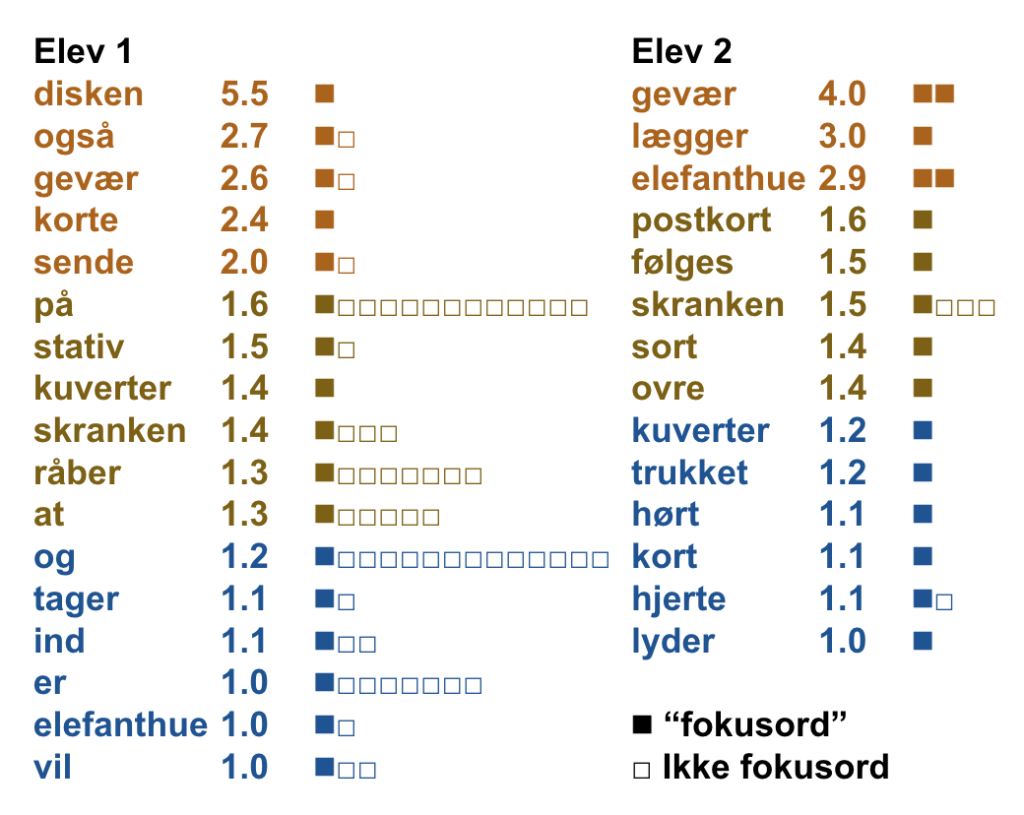
Focus words are somewhat similar to reading errors, because reading errors are also a source of breakdowns in comprehension, and because reading errors can reveal patterns in a student’s reading difficulties. Reading errors that are marked systematically and converted into a percentage can also indicate a reader’s general level, and thereby identify the students with the greatest difficulties. Reading errors are used, for example, in Running Records and in the Danish assessment material Individuel Læseprøve. These methods require an experienced reading specialist to listen and mark the reading errors by hand.
EyeJustRead finds the focus words automatically, based on the reader’s eye movements during reading. EyeJustRead knows how many words each student reads and how long each word is looked at, so it can easily calculate a focus word percentage and sort the lists of focus words. From each focus word, the teacher can go straight to the point in the recording of the student’s reading where the word was read, and get a precise impression of the student’s actual reading behaviour on the focus words. In a reading programme, teacher and student can follow up on the student’s use of conscious reading strategies on focus words. It is of course especially interesting to follow how conscious reading strategies develop over time, and thereby get confirmation that the intervention has worked as intended.
Because the focus word percentage resembles the error percentage, and because eye movements are used in reading research in other contexts, we expect the focus word percentage to reflect the reader’s level. That is why we have gone on to investigate whether this expectation holds.
In the video, reading researcher Stine Engmose, PhD and assistant professor at University College Absalon, and Sigrid Klerke, PhD in language technology and eye-tracking, present how a validation study was carried out, along with selected results*. Once the focus word percentage is validated, a screening of groups of students, where each student reads for a couple of minutes in the same book in EyeJustRead, can give the reading specialist a simple overview of each reader’s focus word percentage. From the overview, the specialist can go straight to each reader’s list of focus words, see what interrupted the student’s fluent reading, and plan teaching accordingly.
* The results presented in the video had not yet been peer-reviewed when it was recorded.
Want to see focus words in your own students’ reading? Try the EyeJustRead demo free for 4 weeks, or contact us.